 Provides total design flow at pick-up points sufficient to control dust
Wouldn’t we all like to save our bosses $50,000 annually! Designing an energy efficient dust collection system is one way to accomplish this feat.
First, we need to define what constitutes a good dust control system:
Provides total design flow at pick-up points sufficient to control dust
Is low maintenance
Is designed with worker and property safety in mind
Meets required dust emission standards
Uses the least electrical energy practical to accomplish the above
Has the flexibility to accommodate varying flows and pressures or future
system requirements
Is price competitive on a first cost basis, while being the low cost
choice over the life of the system
Most Northwest systems evolved from cyclones and decisions that were predicated on 1¢ per kW-Hr power that we had 20 years ago. Later, in the mid 1970’s pollution control authorities required filtration of the cyclone’s emission. To this end, secondary filters were positioned after the cyclones with abort gates ahead of them so production could be maintained even if this secondary filter didn’t work trouble free.
Figure #1 illustrates this typical layout:
FIGURE #1
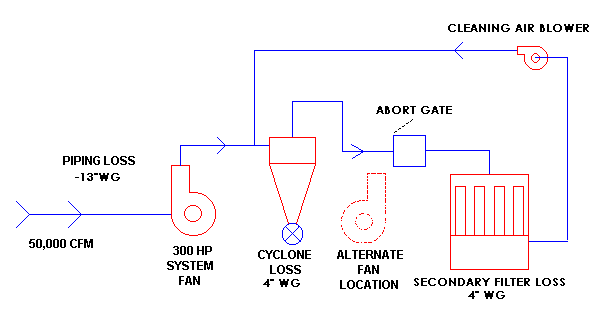
Unfortunately, this layout is still being proposed for new systems today. By configuring your dust collection system as in figure #2, you accomplish the following improvements:
FIGURE #2
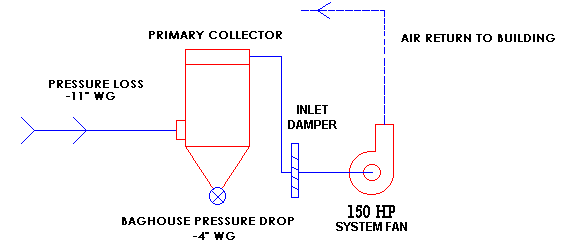
Lower maintenance because of less equipment and no material wear on the
fan
Lower electrical usage because the clean side system fan is 80-83%
efficient rather than 55-60% for most paddle fans. There is less system pressure
drop because the cyclone loss is eliminated and larger slower velocity ductwork
is used. The simple calculation for fan Brake Horsepower (BHP) is: BHP = CFM x
SP divided by 6356 x SE
Thus reducing the system Static Pressure (SP) from 22" WG to 15" WG and improving the fan Static Efficiency (SE) from 60% to 82% we save 50% in electrical costs. The electrical savings can even be greater by using an automated system fan inlet volume control damper. This damper closes to save horsepower early in the life of the filter bags when their loss is only 1" WG rather than the full 4" WG allowed for in the system fan design. An added benefit is that maintaining the constant design volume of air through the baghouse leads to extended bag life.
System safety is also better in figure #2 because the volume control damper insures you always have the system design flow and subsequent design transport velocity in the ductwork. Keeping ductwork clean deprives a fire of fuel on its path to the dust collector.
Primary collectors, as in figure #2 from reputable manufacturers are usually considered the "Best Available Control Technology" (BACT) and the preferred collection device by EPA authorities. More often authorities are requiring owners of systems with abort gates ahead of their baghouse to turn themselves in each time the abort is used. This can get very expensive and brings a great deal of unwanted scrutiny to a plant site.
Furnishing the system fan with an inlet vane volume control damper you can buy a larger collector and run initially at lower flows while not using any more horsepower than the lower flow rate would require. The damper can automaticly vary flow rates throughout the operating day and save horsepower accordingly.
Too often ductwork is sized based on 5,000 to 6,000 FPM velocities. This is a throwback to 1¢ per kWh power rates and systems without volume control dampers. Using smaller diameter ducts translates to higher velocities for the same air volume and a reduced first-cost enticement by the contractor. This practice is incredibly shortsighted based on today and tomorrow’s projected electric rates. For example, if we had an 12" diameter duct transporting 4,700 CFM at 6,000 FPM velocity it will take 85% more resistance and thus, 85% more electrical horsepower than using a 14" diameter duct transporting the same flow at 4,400 FPM. The slightly larger pipe costs more, initially, but will usually pay for itself the first few months of operation.
Many people believe that they have to transport at velocities in excess of 4,000 FPM in order to keep chips in suspension. This flies in the face of science as most air density classifiers used for separating chips from rocks and ice use a velocity around 2,500 FPM to separate /transport the wood chips vertically. If ductwork transitions and side branches are designed by SMACNA standards or the Industrial Ventilation Guide, then 3,500 to 4,000 FPM velocities are more than adequate for almost all wood chip handling and dust control applications.
Whether or not to install a fire or explosion suppression system is a major consideration for many dust collector owners. Many times owners decide there is no economic advantage in having a suppression system. The first line of defense to avoid baghouse fires is to ensure that your system maintains design volume and hence design duct velocity so that the ducts stay clean. Without fuel in the bottom of the duct or stuck to the sides, it is very difficult for a fire to sustain itself from the original heat generation source to the baghouse. A fan volume control damper as in Figure #2 makes this easy. Systems like Figure #1 pass material through the fan and make it difficult to install volume control dampers on the fan to ensure adequate duct velocity.
There are many types and brands of spark/fire suppression that can be used with dry baghouses. There are dry powder suppressants system to snuff out explosions, inert gas suppression agents, steam injection systems and plain old water spray systems. The type system selected to protect your baghouse, personnel and/or buildings often times depends on the climate conditions the system will have to operate in, the space available to install it, or whether the suppression system selected will activate too often, thus shutting down the collection system and subsequently, production. The system selected must always be compatible with both production and some defined amount of safety.
With dry powder, steam and inert gas suppression systems, many dust collectors and ductwork problems are avoided. With wet suppression systems, water is periodically sprayed into the ductwork and collector, thus wetting surfaces, which subsequently build up dust cake. This can cause bridging problems in hoppers and airlocks as well as shortened bag life if the water vapor reaches the bags. Dry powder suppression systems often do not require or use abort gates, hence the EPA does not become involved every time a spark is detected. Most importantly, powder systems are as gas systems, dry and compatible with dry dust collectors.
In conclusion, taking a system approach to air pollution control will save you money, maintenance time and improve your production while making you more competitive.
Copyright 1999-2000, Wm. F. Baxter
 back
back